
Last updated July 10, 2026
Garage Door Repair Maintenance Checklist for Bridgeport Homeowners
Here’s what most Bridgeport homeowners get wrong about garage door maintenance: they treat it like a car oil change — same tasks, same schedule, any season. But in our 17 years of service calls across Black Rock, North End, and the East Side, we’ve found that lubricating a worn torsion spring doesn’t extend its life. It masks the metal fatigue until the spring snaps at 6 a.m. on a January Monday, usually with a car trapped inside and a school commute in 45 minutes. This guide is built from the actual failure patterns we see in coastal Connecticut — not a generic manufacturer’s checklist repackaged with a new logo. You’ll learn the 20-minute, twice-a-year inspection that prevents the three most expensive emergency calls we handle, what the salt air off Long Island Sound does to your hardware that inland checklists ignore, and the specific DIY mistakes that turn a $180 adjustment into a $900 replacement.
Quick Answer
A proper garage door maintenance checklist for Bridgeport homeowners includes a twice-yearly 20-minute inspection focused on spring balance, cable condition, roller wear, and track alignment — with critical attention to salt-air corrosion on bottom brackets and torsion hardware before winter sets in. Lubricate the spring, hinges, and rollers with silicone-based spray only; never use WD-40 on tracks or bearings. Test door balance by disconnecting the opener and lifting manually — if it doesn’t stay put at waist height, your springs are failing and need professional replacement.
Table of Contents
- Why Bridgeport Garage Doors Fail Differently Than Inland Homes
- The 20-Minute Twice-a-Year Inspection
- What to Lubricate — and What Never to Touch
- The Balance Test: What Results Actually Mean
- Reading Your Cables Before They Snap
- Opener Maintenance Beyond the Obvious
- Seasonal Timing: When to Do What in Bridgeport
- Common Mistakes to Avoid
- When to Call a Professional
- Frequently Asked Questions
- The Bottom Line
Why Bridgeport Garage Doors Fail Differently Than Inland Homes
Bridgeport sits on Long Island Sound with average humidity pushing 72% in summer and winter air that carries salt from coastal storms straight into garage door hardware. We’ve replaced torsion springs in Black Rock homes that failed in 8 years instead of the typical 15, and the difference was always the same: corrosion at the stationary cone and bottom bracket where salt-laden moisture collects and never fully dries.
Inland Connecticut cities like Hartford see primarily wear-based failures — metal fatigue from cycles, dried bearings, standard stuff. Bridgeport gets accelerated electrochemical corrosion on galvanized components that inland checklists don’t address because they don’t have to. A homeowner in North Haven might inspect their door once a year and do fine. In Bridgeport’s coastal zones — from Seaside Park north through the East Side — we’re looking at pre-winter corrosion inspection as non-negotiable.
The other Bridgeport-specific factor is housing stock age. Much of the city’s residential inventory dates to the 1920s–1950s, with garages that weren’t built for modern insulated doors. We regularly see 16-foot wide openings with original wood jambs that have settled, creating binding and uneven cable wear that a standard checklist misses entirely. Daniel handles these himself — no dispatched strangers — because diagnosing settled framing versus hardware failure takes field experience you can’t train into a subcontractor in a weekend.
Key inspection differences for Bridgeport:
- Check bottom brackets and torsion spring cones for white or orange rust bloom before November
- Inspect weatherstripping at the bottom seal more frequently — salt spray degrades rubber faster than UV alone
- Look for wood jamb rot or settling at hinge attachment points, especially in pre-war homes
- Monitor opener strain — older garages often have header clearance issues that force non-standard opener installations working harder than designed
The 20-Minute Twice-a-Year Inspection
This isn’t an all-day project. We’ve timed it. A thorough inspection takes 20 minutes if you know what you’re looking for, and doing it in October and April catches 90% of the failures that become emergency calls. October matters because you’re heading into freeze-thaw cycles with hardware that may already be compromised. April matters because you’ve just stressed everything through a Bridgeport winter.
October Inspection (Pre-Winter):
- Visual sweep (3 minutes): Close the door and stand inside with the lights off. Look for daylight gaps around the perimeter — uneven gaps mean binding or settled track. Check the bottom seal for cracking or compression. In coastal Bridgeport neighborhoods, also look for salt residue streaking on the interior door face — that means wind-driven spray is reaching hardware.
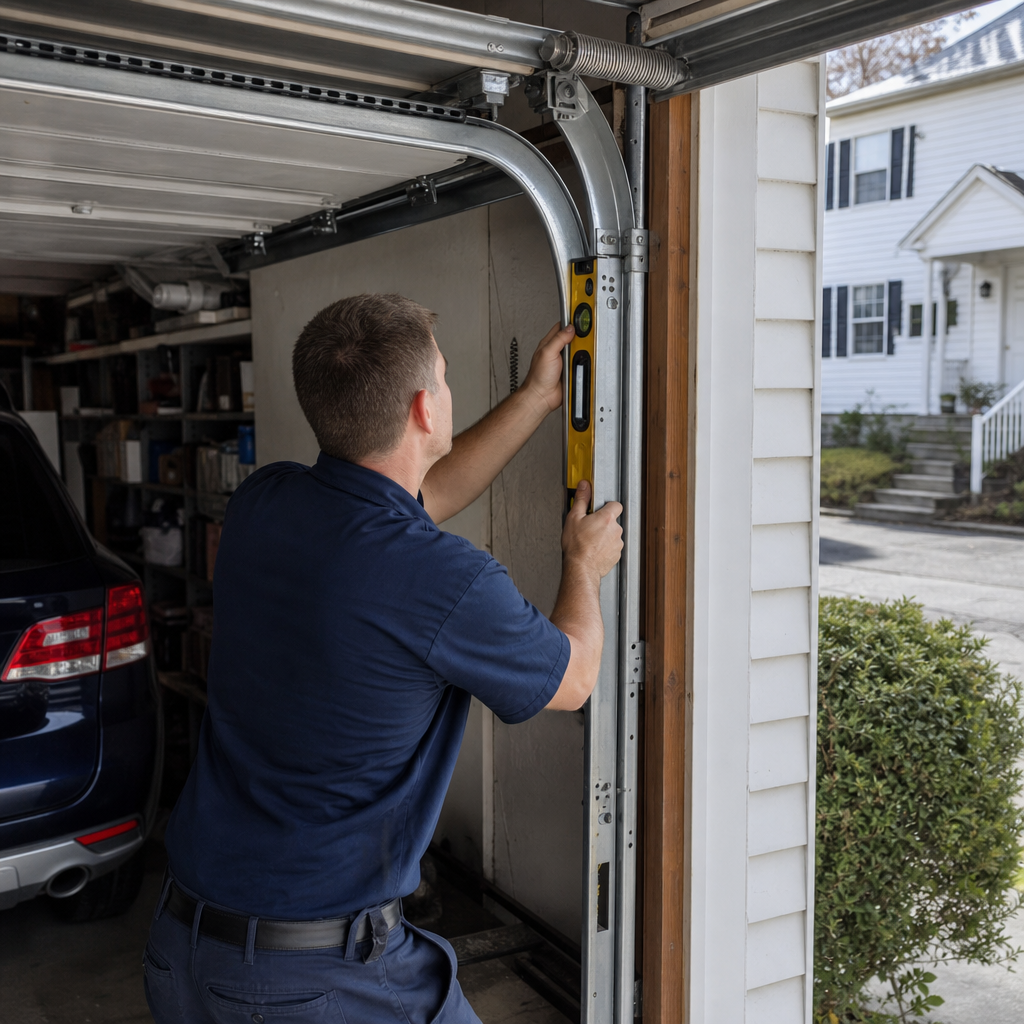
- Hardware torque check (4 minutes): With the door closed, wiggle each roller in its track. Any play more than 1/8 inch indicates worn roller bearings. Check hinge bolts with a socket wrench — don’t over-tighten, just confirm they’re snug. We’ve found loose hinge bolts on 40% of Bridgeport service calls; vibration from daily cycling backs them out over time.
- Spring and cable inspection (5 minutes): This is the critical one. Examine torsion springs for gaps in the coils, rust scaling, or any shiny “new metal” spots where the coating has failed. Check cables where they wrap around the bottom drum — fraying always starts at the drum contact point, not the middle of the cable run. Look for broken strands poking outward like whiskers.
- Balance test (5 minutes): Detailed in the next section — this single test tells you more than everything else combined.
- Opener force and safety reverse (3 minutes): Place a 2×4 flat on the floor where the door closes. The door should reverse on contact. If it doesn’t, the force setting is too high — a safety hazard and a sign the door is binding somewhere, making the opener work too hard.
April Inspection (Post-Winter):
- Repeat the visual sweep, focusing on bottom seal damage from snow and ice
- Check for corrosion expansion at bottom brackets — salt corrosion can actually swell the bracket, causing roller binding
- Re-test balance — springs weaken most during heavy winter use when cold-stiffened seals increase door weight
- Inspect opener rail for lubricant breakdown — cold thickens old grease, causing drag marks
What to Lubricate — and What Never to Touch
This is where we reverse more DIY damage than any other single issue. Homeowners in Bridgeport’s North End, Brooklawn, and throughout the city mean well, but they’re working from advice that applies to squeaky hinges on interior doors, not 150-pound garage door systems under spring tension.
Lubricate these — with silicone spray or white lithium grease only:
- Torsion springs: Light coating across the coil surface reduces friction between active coils. This doesn’t fix a failing spring, but it reduces the noise that masks progressive failure. In Bridgeport’s salt air, this also provides a moisture barrier.
- Hinge pins: The pivot points where hinge leaves meet. One quick shot, work the door manually to distribute.
- Roller bearings (steel rollers only): The bearing at the roller center, not the wheel surface that contacts track. If you have nylon rollers, the bearings are sealed — don’t lubricate, just replace when worn.
- Opener rail: Light coating on the screw or chain drive, per manufacturer spec. Belt drives don’t need lubrication.
Never lubricate these — and why:
- Tracks: WD-40 on tracks is the most common mistake we correct. Tracks aren’t a friction surface — rollers roll, they slide. Lubricant on tracks attracts dust and grit, creating an abrasive paste that accelerates wear. If your door binds in the track, the track is bent, the rollers are worn, or the door is unbalanced. Lubrication masks the real problem until something breaks.
- Bottom brackets: These are under extreme cable tension. Lubricant here attracts corrosion-accelerating grit and provides no functional benefit. The bracket-to-jamb connection is static; the cable moves through the bracket slot, but that’s not a friction point that benefits from lubrication.
- Extension springs (if present): The safety cable through the spring center is there because these springs fail violently. Lubrication doesn’t extend life and makes the safety cable slippery, potentially reducing its effectiveness during a failure.
We stock parts for the brands you actually own — LiftMaster, Chamberlain, Genie, Clopay, and the others — and we can tell you in 30 seconds over the phone whether your specific hardware needs lubrication or replacement.
The Balance Test: What Results Actually Mean
The balance test is the single most informative diagnostic you can perform, and most Bridgeport homeowners have never done it correctly. Here’s the proper procedure, and more importantly, how to interpret what happens.
How to perform the test:
- Close the door fully.
- Pull the emergency release cord — usually a red handle hanging from the opener trolley. This disengages the opener from the door.
- Lift the door manually from the bottom center (never from the sides — that’s where fingers get pinched).
- Lift to waist height (about 3 feet off the ground) and release.
What the results mean:
Door stays put at waist height: Springs are properly balanced. The door’s weight (typically 130–180 pounds for a standard steel door) is counterbalanced by spring torque. This is the only “pass” result.
Door rises on its own from waist height: Springs are over-torqued or the wrong springs were installed. This strains the opener on descent and creates excessive cable wear. We’ve seen this in Bridgeport homes where a previous owner installed “heavy duty” springs thinking bigger was better.
Door falls from waist height: Springs are weak or failing. The door weight exceeds spring counterbalance. This is the dangerous one — the opener is working overtime, cables are shock-loading on every close, and the spring is within cycles of failure. In our experience, a door that won’t hold at waist height in October fails completely by February in Bridgeport’s cold-stiffened conditions.
Door feels heavy to lift or binds during travel: Track misalignment, roller wear, or — common in Bridgeport’s older homes — settled jambs creating twist in the door frame. This isn’t a spring issue; it’s a geometry issue that gets worse with temperature swings.
Safety note: Torsion springs store massive mechanical energy. If your balance test indicates spring problems, do not attempt adjustment yourself. The winding bars required for safe adjustment are specific solid steel bars, not screwdrivers or makeshift substitutes. We’ve responded to emergency calls where homeowners attempted this and the results required stitches. Daniel handles spring work himself — it’s not delegated for good reason.
Reading Your Cables Before They Snap
Garage door cables fail without warning — except they don’t, not really. The warning signs are there if you know where to look, and in Bridgeport’s salt-air environment, they appear earlier and progress faster than inland locations.
Cables are twisted aircraft-grade steel, typically 7×19 construction (7 strands of 19 wires each). They wrap around a drum at the top of the door and attach to the bottom bracket. The failure pattern is predictable: individual wires break at stress points, the broken ends splay outward, and the reduced cross-section eventually fails under load.
Inspection points — check these specifically:
- Drum wrap zone: Where the cable first contacts the drum as the door opens. This is the highest-stress point. Look for “whiskers” — broken wire ends poking from the cable surface. Even one visible whisker means 1/133 of the cable’s strength is gone, and the stress redistributes to remaining wires.
- Bottom bracket attachment: The cable passes through a slot in the bottom bracket and is secured with a wedge or bolt. Fraying here indicates bracket edge wear or cable misalignment from settled jambs.
- Mid-cable contact points: On some installations, cables can contact door edges or track hardware. Look for polished or flattened spots where rubbing has worn the outer wires.
In Bridgeport’s coastal climate, we also see accelerated corrosion inside the cable structure — rust that isn’t visible on the surface but has already weakened interior wires. If your cables are more than 10 years old and you live within a mile of the Sound, consider proactive replacement. The $240 cable replacement beats the $600+ emergency call when a cable snaps with your car inside and the door jammed at a 30-degree angle.
We stock cables for all major brands — Clopay, Wayne Dalton, Amarr, and others — sized to your door weight and height. Wrong-size cables are a common source of premature failure we correct on service calls.
Opener Maintenance Beyond the Obvious
Most opener “maintenance” advice stops at “check the batteries in your remote.” Here’s what actually matters for longevity, especially in Bridgeport’s older housing stock where openers often work harder than designed.
Force and limit settings: These aren’t set-and-forget. As springs weaken, rollers wear, and seals compress, the door’s operating characteristics change. The opener compensates by working harder — until it can’t. Check the force setting annually: the door should reverse on a 2×4 obstruction, but not so easily that wind or seal drag triggers false reversals. In Bridgeport’s variable weather, seal drag changes seasonally, so the sweet spot shifts.
Chain or screw drive tension: A sagging chain bounces, creating erratic door movement and premature gear wear. A screw drive with dried lubricant chatters and overheats the motor. Both are 5-minute checks with the opener manual in hand.
Logic board environment: Bridgeport garages in pre-war homes often have minimal insulation and no climate control. Opener electronics hate temperature swings and humidity. If your opener is mounted on an uninsulated ceiling near a roof leak path, the logic board is aging faster than designed. We replace more LiftMaster and Chamberlain logic boards in Bridgeport than in Hartford for exactly this reason — coastal humidity finds its way into every housing seam.
Battery backup (if equipped): Connecticut power outages aren’t rare, and a garage door stuck closed during an outage is a fire egress issue if your home’s other exits are compromised. Test the battery backup quarterly — unplug the opener and verify the battery engages. Replacement batteries typically last 3–5 years but degrade faster in temperature extremes.
Garage door stuck at 9 PM? That’s exactly why we offer emergency service. Daniel carries opener parts for all eight major brands on his truck, including logic boards and drive gears that most companies have to order.
Seasonal Timing: When to Do What in Bridgeport
Timing matters as much as the tasks themselves. Bridgeport’s coastal climate creates distinct maintenance windows that inland checklists ignore.
October (Pre-Winter): The critical window. Salt air corrosion has accumulated through summer humidity; freeze-thaw cycles will soon exploit every weakness. Focus on corrosion inspection, seal condition, and balance verification. If springs are marginal, replace them now — not in January when they’re cold-stiffened and your car is trapped.
November–February: Minimal maintenance season. Visual checks only — look for new gaps, listen for changed sounds, watch for opener strain indicators (slower operation, motor laboring). Do not lubricate in freezing temperatures — the solvent carriers in most sprays gel and attract moisture.
April (Post-Winter): Full inspection repeat. Winter stress reveals what October only suspected. Pay special attention to bottom seal compression from snow weight, opener rail lubricant condition, and any balance degradation.
July–August: Optional mid-year check in high-use homes. Focus on opener thermal protection — if your garage exceeds 90°F regularly, the opener motor is working harder and the logic board is thermally stressed.
Neighborhood-specific note: Homes in Black Rock and the waterfront areas see more aggressive salt exposure than inland Bridgeport neighborhoods like Brooklawn or the Upper East Side. If you’re within three blocks of the Sound, treat October inspection as mandatory, not recommended.
Common Mistakes to Avoid
- Using WD-40 as a general lubricant: WD-40 is a water displacer and light solvent, not a lubricant. On garage door components, it strips existing grease, attracts dust, and evaporates within days — leaving metal drier than before. We remove WD-40 residue on roughly one in five Bridgeport service calls.
- Lubricating a failing spring: A noisy spring isn’t asking for oil; it’s announcing metal fatigue. Lubrication quiets the symptom, the homeowner stops monitoring, and the spring fails catastrophically — usually at maximum inconvenience. In the North End last winter, we replaced three springs that had been “quieted” with spray lubricant in September.
- Ignoring the emergency release: Many Bridgeport homeowners have never pulled the red handle and don’t know if it works. If the opener fails during a power outage and the release is corroded stuck, you’re trapped or cutting the cable. Test it twice a year — it’s 10 seconds that could matter enormously.
- Adjusting track alignment without understanding geometry: A binding door isn’t fixed by loosening track bolts and eyeballing it. The door’s vertical track must be plumb, the horizontal track must slope precisely toward the opener, and the two must meet at the correct radius. Misaligned tracks accelerate roller wear and can derail the door entirely.
- Replacing one spring on a two-spring system: Torsion springs are matched pairs. Installing one new spring with one old spring creates torque imbalance that wears cables, drums, and the opener unevenly. We always replace torsion springs in pairs — it’s not upselling, it’s correct repair.
- Delaying service until complete failure: The $180 spring adjustment becomes the $900 door-off-tracks-and-cable-snap because the homeowner “was going to call next week.” 526 homeowners have left a review — many mention they wish they’d called sooner.
When to Call a Professional
Some maintenance is homeowner-appropriate; some isn’t, for safety and technical reasons. Call Guardian Garage Door Repair Connecticut at (855) 483-0709 for free estimates in Bridgeport when you encounter:
- Any torsion spring issue — adjustment, replacement, or suspected failure. The stored energy is genuinely dangerous.
- Cable fraying or any broken strands visible. Cables fail under load, not at rest, and the load is highest when you’re opening the door with your car underneath.
- Door derailment or track damage. This is structural repair requiring proper tools and door-weight knowledge.
- Opener electrical issues — buzzing, burning smell, or erratic operation. Logic board failures can damage motors if not addressed.
- Any maintenance result that surprises you. If the balance test behaves unexpectedly, if you find corrosion you didn’t expect, if something just sounds different — trust that instinct.
Daniel handles it himself — no dispatched strangers. 17 years, one owner, one standard of work. Emergency garage door service available for urgent situations.
Frequently Asked Questions
Professional maintenance inspection and tune-up in Bridgeport typically runs $120–$180, including lubrication, hardware torque verification, balance testing, and safety system checks. If we find worn components during inspection, replacement parts are quoted separately with upfront pricing before any work proceeds. Call (855) 483-0709 for an exact quote — estimates are free.
Homeowners can safely perform visual inspections, balance tests, remote battery checks, and light lubrication of hinges and rollers. Torsion spring work, cable replacement, track realignment, and opener electrical service should always be handled by a trained technician — the injury risk from high-tension components is significant, and improper repair often creates more expensive damage. In our experience, the DIY maintenance that prevents emergencies is exactly what this checklist covers; the work that requires a truck roll is the work that can hurt you.
Twice yearly — October before winter and April after — with the October inspection being more critical due to salt-air corrosion and approaching freeze-thaw stress. Homes within a mile of Long Island Sound should add a quick visual check in January for corrosion expansion at bottom brackets. The full 20-minute inspection routine takes less time than a coffee run and prevents the emergency calls that start at $300 and climb fast.
Cold thickens lubricants, stiffens rubber seals, and contracts metal components — all of which increase friction and operational noise. In Bridgeport, the effect is amplified because salt corrosion has already roughened bearing surfaces by the time temperatures drop. A door that was marginally lubricated in October becomes genuinely noisy in January. The fix isn’t more lubricant in freezing weather (it won’t penetrate properly); it’s proper pre-winter maintenance and addressing any corrosion before cold weather locks it in.
For doors under 15 years old with isolated component failure — one bad spring, worn rollers, failed opener — repair is almost always more economical, typically $180–$500 versus $1,200–$2,800 for quality replacement. Replacement becomes the better value when the door has multiple simultaneous failures, significant panel damage, or outdated insulation that drives heating costs. We assess this honestly on every call; 17 years in the trade means we’ve seen when repair is throwing good money after bad. Call (855) 483-0709 for a no-pressure evaluation.
We stock parts for all eight major residential brands: LiftMaster, Chamberlain, Genie, Clopay, Amarr, Wayne Dalton, Craftsman, and Raynor. This includes springs sized to door weight and height, cables, rollers, hinges, weatherstripping, opener drive components, and logic boards. We don’t push proprietary parts or exclusive brand relationships — we carry what Bridgeport homeowners actually have installed.
The Bottom Line
Bridgeport garage door maintenance isn’t about doing more — it’s about doing the right things at the right times. The 20-minute October and April inspection, focused on balance, cables, corrosion, and correct lubrication, prevents the three emergency calls we handle most: spring failure with trapped vehicles, cable snap with door derailment, and opener burnout from years of compensating for unbalanced doors. Salt air from Long Island Sound accelerates everything, making timing more critical here than inland. Do the inspection, know your results, and call when the test indicates trouble rather than after something breaks. The cost of prevention is measured in minutes; the cost of emergency repair is measured in hundreds of dollars and ruined mornings.
Need a hand with your inspection, or ready to address something you found? Call Guardian Garage Door Repair Connecticut at (855) 483-0709 for a free estimate. Daniel Lopez personally handles service calls across Bridgeport — from Black Rock to the East Side, from Brooklawn to the waterfront — with 17 years of hands-on experience and same-day availability for urgent situations.
Written by Daniel Lopez, Owner & Lead Technician at Guardian Garage Door Repair Connecticut, serving Bridgeport since 2009.